

HEALTHCARE IT NEWS & BLOG
AI Governance in Healthcare: Why You Can't Afford to Skip It
AI is in your clinical workflows, your documentation, your revenue cycle. If governance isn't keeping pace, you're carrying more risk than you realize.
Healthcare organizations are moving fast on AI, and the efficiency gains are real. Faster clinical documentation. Automated prior authorizations. Predictive models that flag readmission risk before a patient leaves the floor. The tools work. The problem is that most organizations are deploying them without any governance structure in place, and that gap is where the liability lives.
Industry awareness of AI governance jumped from 40% to 70% in the last year. The sector knows it matters. What's lagging is execution.
What Governance Actually Looks Like in Practice
It's not a policy document that lives on a shared drive. AI governance is a set of operational systems: validation processes, audit trails, escalation protocols, and cross-functional accountability that govern how tools are deployed, monitored, and corrected over time.
Without it, you're deploying clinical AI faster than you can manage the exposure. Physicians distrust outputs they can't verify. Compliance teams can't produce audit trails when regulators ask. And when a model quietly degrades over time, there's no mechanism to catch it until something breaks.
Health systems that skip governance follow a predictable pattern: liability exposure, physician distrust, and eventually rolling back tools they spent months getting live, getting it right up front costs significantly less than unwinding it later.
Where Governance Breaks Down Most Often
Validation gaps. AI tools often get deployed after vendor demos and limited internal testing, without validation against your specific patient population, EHR environment, and care protocols. What performs well at an academic medical center may not perform as well at a community hospital.
No ongoing monitoring. Models drift. Patient populations shift. A tool that performed well at go-live can quietly degrade over months without anyone noticing until a clinical or billing error surfaces. Governance means building monitoring into operations, not treating deployment as the finish line.
Siloed ownership. When IT owns the tool, legal owns the risk, and clinical teams own the workflows, nobody actually owns governance. The organizations getting this right are building cross-functional steering with clear accountability and treating it as infrastructure.
Where to Start
You don't need a perfect framework before you move. You need a starting point: an inventory of the AI tools currently running in your organization, a clear owner for each one, and a basic set of monitoring criteria. From there, governance scales with your AI footprint.
If your organization is early in AI adoption, now is the right time to build the foundation. If you're already deep into deployment without a governance structure, the priority is a rapid assessment. Understand what's running, where the exposure is, and what needs immediate attention.
Safeguard Consulting Group works with healthcare organizations to build governance frameworks that are operational from day one. Whether you're starting from scratch or hardening an existing program, we help you move forward with confidence.
AI adoption in healthcare is not slowing down, and regulatory expectations around it are only going to increase. The organizations building governance now will have the least disruption when the scrutiny arrives. And it will.
Ready to assess your AI governance posture? Contact us at info@safeguardcg.com
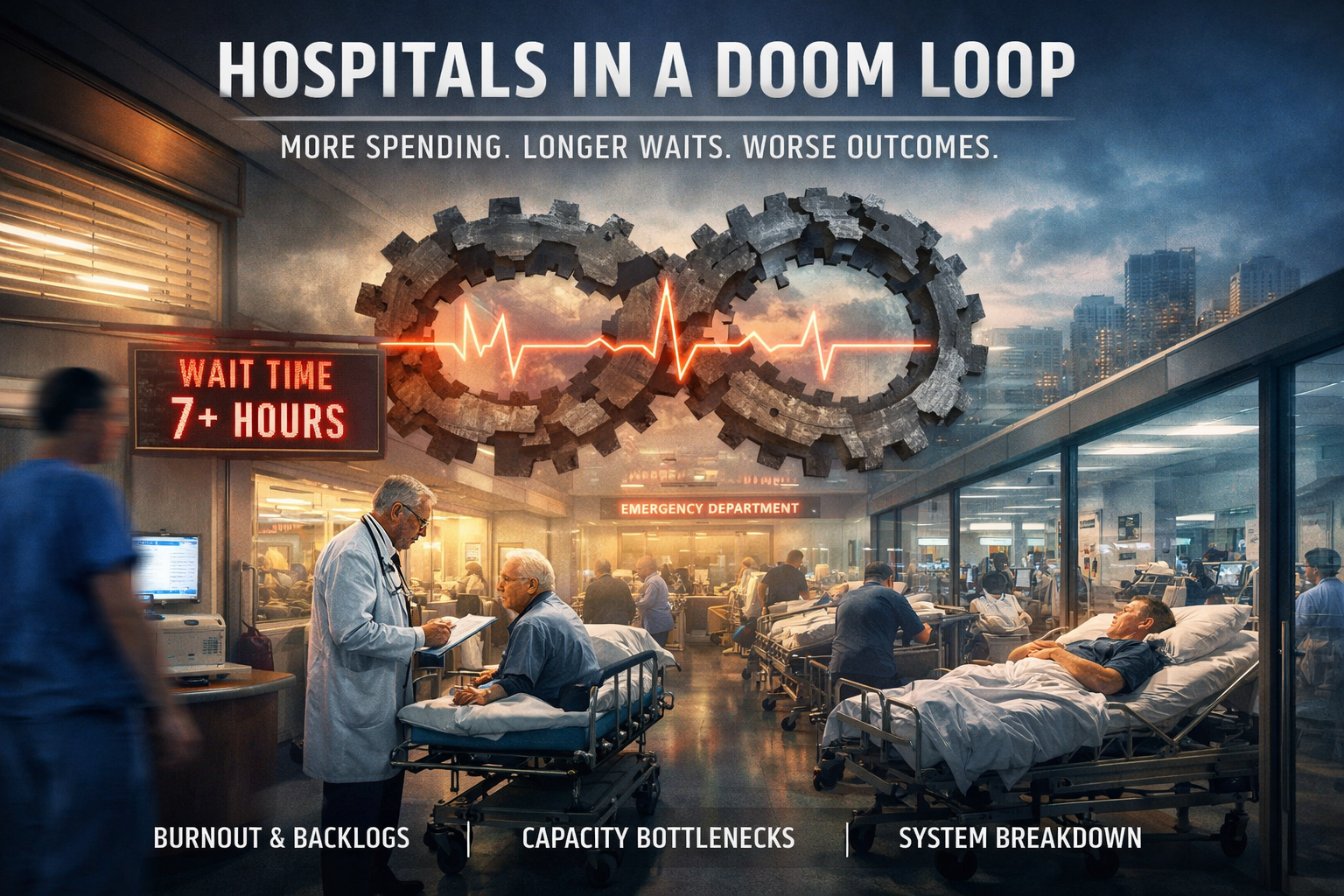
Hospitals in a Doom Loop: Why Healthcare Is Slowing Down as Spending Rises
Hospitals are spending more and staffing more, yet moving patients slower than ever. The issue isn’t resources. It’s broken flow. As delays compound and patient complexity rises, healthcare systems are trapped in a self-reinforcing loop that funding alone can’t fix.
Hospitals are doing more than ever and getting less done.
Spending is up. Staffing levels have increased. Technology investment has never been higher. Yet patients are waiting longer, outcomes are slipping, and frontline staff feel like they are moving slower, not faster.
A recent analysis from The Economist puts a name to what many operators already know: hospitals are stuck in a self-reinforcing loop that is degrading performance instead of improving it.
The Shift No One Reversed
The healthcare system did not recover from the pandemic. It adapted to dysfunction.
During COVID, hospitals were forced into reactive mode. Elective procedures stopped. Throughput collapsed. Backlogs built. Staff stretched beyond sustainable limits.
That was expected.
What wasn’t expected is that the system never returned to baseline. The temporary state became permanent.
Patients came back sicker. Staffing came back less experienced. Processes came back slower.
And the system locked into a new equilibrium.
A worse one.
The Loop That Is Breaking Hospitals
The problem is not isolated. It compounds.
Patients wait longer to be seen.
Longer waits mean more advanced illness.
More advanced illness requires longer, more complex care.
Longer care blocks beds and staff.
Blocked capacity increases wait times again.
This is not congestion. It is a feedback loop.
Hospitals are no longer dealing with volume spikes. They are operating inside a system that continuously manufactures delay.
Why More Money Made It Worse
The instinctive response has been to add resources.
More staff. More funding. More capacity.
But output has not followed.
Because healthcare is no longer constrained by inputs. It is constrained by flow.
Adding staff into a slowed system does not increase throughput. It often reduces it. Newer clinicians require more coordination. Decision-making slows. Variability increases.
At the same time, every patient now consumes more time.
Deferred care during the pandemic created a wave of higher-acuity cases. Chronic illness is rising. Aging populations are increasing demand intensity, not just demand volume.
So even as staffing numbers rise, effective capacity falls.
More people. Less movement.
The Flow Problem No One Owns
Hospitals are not failing on the inside. They are failing at the edges.
A patient who cannot access primary care shows up in the emergency department.
A patient who cannot be discharged stays in a hospital bed.
A patient who needs post-acute care waits because no placement exists.
Every breakdown outside the hospital becomes a bottleneck inside it.
Beds turn into holding areas. Emergency departments turn into queues. Clinicians spend time managing movement instead of delivering care.
What looks like a hospital problem is actually a system problem.
But no one owns the system.
Technology Didn’t Solve It
The industry invested billions into platforms like Epic and Cerner.
Data is everywhere.
But movement is not.
Most systems were built to document care, not accelerate it. They capture information but do not coordinate action in real time. They add visibility without removing friction.
The result is a paradox.
More data. Slower decisions. Lower throughput.
What This Actually Means
Healthcare is not collapsing from lack of investment.
It is stalling from lack of coordination.
Until systems are redesigned around flow, nothing else scales. Not staffing. Not funding. Not technology.
The organizations that break this loop will not be the ones that spend more.
They will be the ones that move faster.
Because in the current environment, speed is capacity.
And right now, capacity is the one thing healthcare no longer controls.