

HEALTHCARE IT NEWS & BLOG

The Hidden Risk Emerging Inside Healthcare Interoperability (Copy) (Copy)
Healthcare interoperability is transforming patient care, but it’s also exposing a growing governance challenge across the healthcare ecosystem. As organizations accelerate interoperability, APIs, AI platforms, and third-party integrations, the conversation is shifting from simply preventing cyberattacks to governing trusted access responsibly.
Healthcare has spent the last decade aggressively pursuing interoperability.
The goal makes complete sense: connected systems, faster access to patient information, improved coordination between providers and payers, and ultimately better patient outcomes.
But a recent report from The Washington Post highlights a growing issue healthcare leaders can no longer afford to overlook.
The concern is not a traditional ransomware attack or an external hacker breaking into hospital systems.
Instead, the issue appears to involve access occurring through the healthcare data-sharing ecosystem itself.
That distinction matters.
Modern healthcare environments are now deeply interconnected through EHR integrations, APIs, health information exchanges, digital health platforms, third-party applications, and AI-enabled workflows. Those connections are critical for operational efficiency and patient care, but they also create new governance challenges that many organizations are still learning how to manage.
Historically, healthcare cybersecurity conversations focused heavily on perimeter defense:
How do we stop attackers from getting in?
Today, the more difficult question may be:
Who already has access, and how well is that access governed?
As interoperability expands, healthcare organizations are increasingly dependent on external vendors, partners, applications, and downstream data relationships. In many cases, the operational risk is no longer coming from a direct breach. It comes from excessive permissions, weak oversight, fragmented identity management, or insufficient visibility into how sensitive data is being accessed and used.
This is where healthcare transformation becomes significantly more complex.
The industry cannot move backward on interoperability. Connected care is essential. AI initiatives, patient engagement platforms, analytics ecosystems, and coordinated care models all depend on trusted data exchange.
But modernization without governance creates exposure.
Healthcare organizations now need to think beyond simple compliance checklists and start treating governance as core operational infrastructure. Security, privacy, interoperability, and operational architecture can no longer operate as separate conversations.
The organizations that will lead the next phase of healthcare transformation will not simply be the most digitally advanced. They will be the ones capable of balancing innovation with operational discipline, visibility, accountability, and patient trust.
At Safeguard Consulting Group, we believe healthcare modernization must be approached with both execution and governance in mind. Technology acceleration is inevitable. The real differentiator will be how responsibly organizations scale it.

Rural Hospitals Have a Narrow Window to Use the New $50 Billion Federal Fund Wisely
Rural hospitals are operating under sustained pressure, with rising costs, workforce shortages, and nearly 200 closures over the past two decades. The new $50 billion federal Rural Health Transformation Program creates a rare opportunity, but the funding is temporary while the challenges are not. The organizations that use this moment to strengthen EHR strategy, improve interoperability, and build connected care models will create lasting stability. Those that treat it as short-term relief will face the same constraints once the funding runs out.
Rural hospitals are under pressure from every direction: tighter margins, workforce shortages, administrative burden, and rising costs. The urgency is not theoretical. The UNC Sheps Center reports 195 rural hospital closures or conversions since January 2005, including 152 since 2010. Separately, the American Hospital Association cited Sheps data showing that proposed federal cuts in 2025 could place more than 300 rural hospitals at risk of closure, conversion, or service reductions. The AHA’s 2026 cost report also found that hospital expenses grew 7.5% in 2025, with workforce costs up 5.6%, supplies up 9.9%, and drug costs up 13.6%.
That is the backdrop for the federal Rural Health Transformation Program, the new $50 billion rural health fund administered by CMS. The program makes $10 billion available each year from fiscal 2026 through fiscal 2030. CMS states that 50% of each year’s funding is distributed equally among approved states, while the other 50% is allocated based on factors such as rural population, rural facilities, and hospital conditions in the state. CMS announced first-year awards to all 50 states on December 29, 2025, with 2026 awards averaging about $200 million per state.
This matters, but the structure of the fund matters even more. KFF notes that the money is temporary, while many of the underlying financial pressures are not. The law provides funding only through 2030, funds must generally be spent by the end of the following fiscal year, and all funds must be spent before October 1, 2032. KFF also notes that the fund was created against a backdrop of much larger projected Medicaid reductions, meaning the rural fund can help stabilize and modernize systems, but it is not a permanent operating backstop.
The practical implication is simple. Rural organizations should not treat this as bailout money. CMS explicitly frames the program around sustainable transformation. The program allows states to fund training and technical assistance for technology-enabled solutions, software and hardware for major IT advances, cybersecurity capability development, technology-driven chronic disease tools, and coordination models that let rural facilities share operations, technology, primary care, specialty care, and emergency services. CMS also says states should prioritize long-term improvements rather than perpetual operating expenses.
That is where EHR strategy becomes central. CMS specifically says upgrades, enhancements, added modules, interfaces, and new functionality for existing EMR or EHR systems are allowable uses of funds and are not subject to the program’s 5% limitation. The 5% limit applies to replacing an existing certified EMR with a completely new one. CMS also says those upgrades should align with CMS and ASTP/ONC interoperability criteria. In other words, rural hospitals do not have to choose between doing nothing and ripping everything out. They can use the fund to strengthen what they already have, connect it better, or selectively move toward a more scalable model.
That makes shared and managed EHR models highly relevant. Epic says health systems have used Community Connect since 2007 to extend their Epic instances to nearby medical groups, allowing them to gain access to Epic without hiring internal support teams or purchasing infrastructure. Epic also says more than 1,000 hospitals and 22,000 clinics using Epic are now live on TEFCA through Epic Nexus, underscoring the growing importance of networked interoperability. Outside Epic, Oracle positions CommunityWorks as a fully managed model for community, rural, and critical access hospitals, and MEDITECH positions MaaS as a cloud-based model that gives smaller organizations enterprise-level tools without major capital investment or on-premise infrastructure.
The case for these models is not just vendor marketing. ASTP’s 2023 hospital interoperability brief found that only 36% of rural hospitals were routinely interoperable, compared with 47% of urban hospitals. It also found that only 22% of independent hospitals were routinely interoperable, versus 53% of system-affiliated hospitals. More broadly, 71% of hospitals said necessary outside clinical information was routinely available at the point of care, but only 42% said clinicians routinely used it when treating patients. That gap is exactly where better implementation, cleaner interfaces, stronger governance, and smarter workflow design matter.
The fund’s rules also make clear what disciplined execution looks like. Broadband infrastructure is not an allowable use of funds. New construction is not allowed. Minor alterations and renovations are capped at 20% of the total award in the childcare example CMS gives. Provider payments are capped at 15% of a state’s award for that category and must tie to specific transformation initiatives and outcomes. CMS has already appropriated the full $50 billion, but it expects states to avoid duplication, avoid supplanting existing funding, and build plans that survive after the federal money ends.
So the real opportunity is not “buy software.” It is to build a rural health operating model that can last after the grant period. For some organizations, that will mean Epic Community Connect. For others, it will mean optimizing an existing platform, adding interoperability layers, tightening cybersecurity, improving referral and transfer workflows, enabling telehealth or remote monitoring, or moving to a managed platform better suited to a rural cost structure. The wrong move is chasing a large technology purchase without a sustainable operating model behind it. The right move is using this funding window to reduce fragmentation, strengthen local access, and create an implementation plan that a rural organization can actually support five years from now.
That is the opening for experienced execution support. Rural hospitals and health systems do not just need strategy decks. They need help evaluating whether to stay, optimize, connect, or migrate. They need program governance, vendor selection discipline, interface planning, legacy data strategy, implementation management, workflow redesign, and change management that fits the realities of rural operations. This is the kind of work Safeguard Consulting Group can support: practical, execution-focused help for rural health initiatives involving Epic Community Connect, interoperability modernization, and right-sized EHR strategies for smaller systems.
The $50 billion rural health fund is real. The window is finite. Rural organizations that turn it into durable operational and clinical improvement will be in a far stronger position than those that treat it like temporary relief
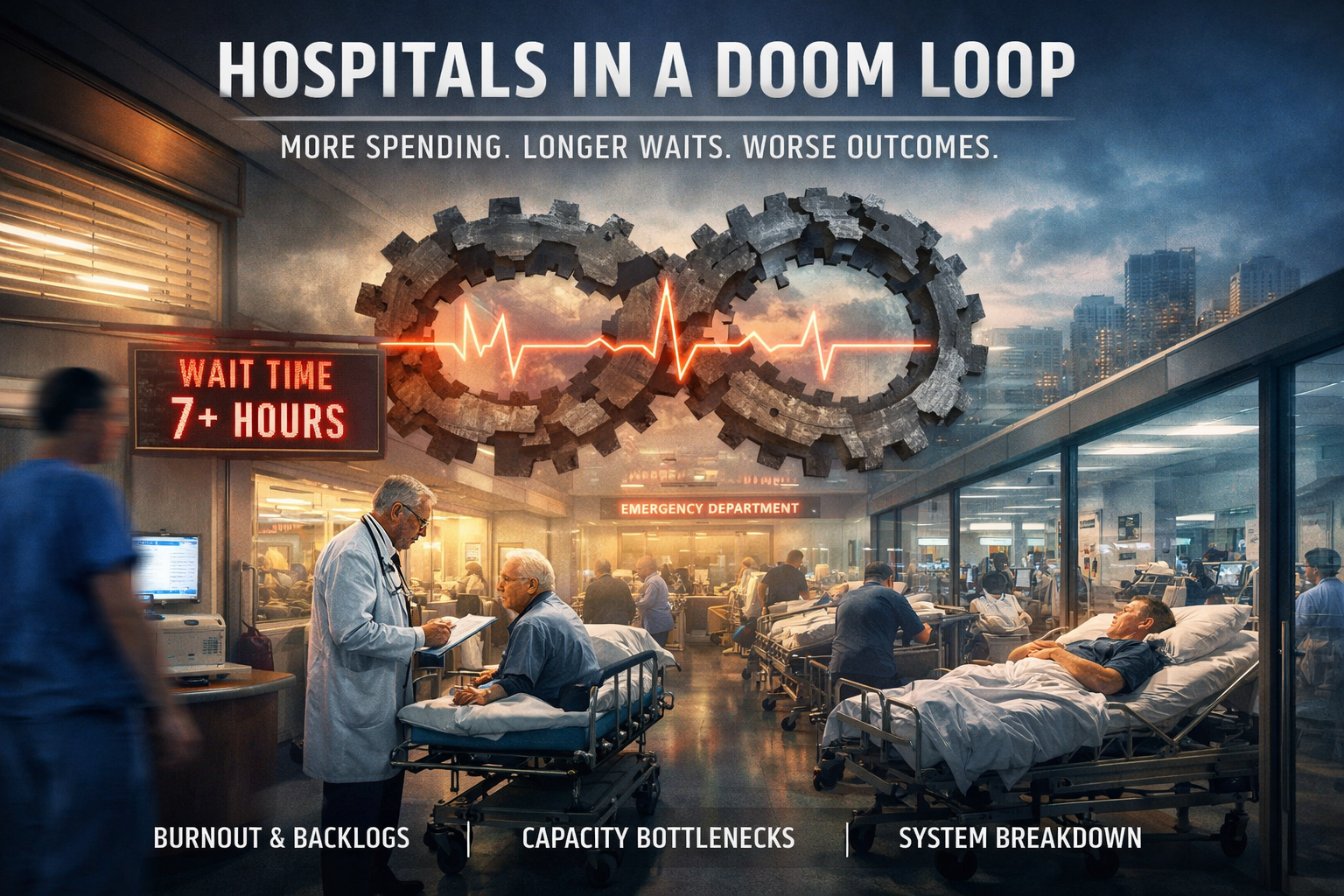
Hospitals in a Doom Loop: Why Healthcare Is Slowing Down as Spending Rises
Hospitals are spending more and staffing more, yet moving patients slower than ever. The issue isn’t resources. It’s broken flow. As delays compound and patient complexity rises, healthcare systems are trapped in a self-reinforcing loop that funding alone can’t fix.
Hospitals are doing more than ever and getting less done.
Spending is up. Staffing levels have increased. Technology investment has never been higher. Yet patients are waiting longer, outcomes are slipping, and frontline staff feel like they are moving slower, not faster.
A recent analysis from The Economist puts a name to what many operators already know: hospitals are stuck in a self-reinforcing loop that is degrading performance instead of improving it.
The Shift No One Reversed
The healthcare system did not recover from the pandemic. It adapted to dysfunction.
During COVID, hospitals were forced into reactive mode. Elective procedures stopped. Throughput collapsed. Backlogs built. Staff stretched beyond sustainable limits.
That was expected.
What wasn’t expected is that the system never returned to baseline. The temporary state became permanent.
Patients came back sicker. Staffing came back less experienced. Processes came back slower.
And the system locked into a new equilibrium.
A worse one.
The Loop That Is Breaking Hospitals
The problem is not isolated. It compounds.
Patients wait longer to be seen.
Longer waits mean more advanced illness.
More advanced illness requires longer, more complex care.
Longer care blocks beds and staff.
Blocked capacity increases wait times again.
This is not congestion. It is a feedback loop.
Hospitals are no longer dealing with volume spikes. They are operating inside a system that continuously manufactures delay.
Why More Money Made It Worse
The instinctive response has been to add resources.
More staff. More funding. More capacity.
But output has not followed.
Because healthcare is no longer constrained by inputs. It is constrained by flow.
Adding staff into a slowed system does not increase throughput. It often reduces it. Newer clinicians require more coordination. Decision-making slows. Variability increases.
At the same time, every patient now consumes more time.
Deferred care during the pandemic created a wave of higher-acuity cases. Chronic illness is rising. Aging populations are increasing demand intensity, not just demand volume.
So even as staffing numbers rise, effective capacity falls.
More people. Less movement.
The Flow Problem No One Owns
Hospitals are not failing on the inside. They are failing at the edges.
A patient who cannot access primary care shows up in the emergency department.
A patient who cannot be discharged stays in a hospital bed.
A patient who needs post-acute care waits because no placement exists.
Every breakdown outside the hospital becomes a bottleneck inside it.
Beds turn into holding areas. Emergency departments turn into queues. Clinicians spend time managing movement instead of delivering care.
What looks like a hospital problem is actually a system problem.
But no one owns the system.
Technology Didn’t Solve It
The industry invested billions into platforms like Epic and Cerner.
Data is everywhere.
But movement is not.
Most systems were built to document care, not accelerate it. They capture information but do not coordinate action in real time. They add visibility without removing friction.
The result is a paradox.
More data. Slower decisions. Lower throughput.
What This Actually Means
Healthcare is not collapsing from lack of investment.
It is stalling from lack of coordination.
Until systems are redesigned around flow, nothing else scales. Not staffing. Not funding. Not technology.
The organizations that break this loop will not be the ones that spend more.
They will be the ones that move faster.
Because in the current environment, speed is capacity.
And right now, capacity is the one thing healthcare no longer controls.