

HEALTHCARE IT NEWS & BLOG
AI Governance in Healthcare: Why You Can't Afford to Skip It
AI is in your clinical workflows, your documentation, your revenue cycle. If governance isn't keeping pace, you're carrying more risk than you realize.
Healthcare organizations are moving fast on AI, and the efficiency gains are real. Faster clinical documentation. Automated prior authorizations. Predictive models that flag readmission risk before a patient leaves the floor. The tools work. The problem is that most organizations are deploying them without any governance structure in place, and that gap is where the liability lives.
Industry awareness of AI governance jumped from 40% to 70% in the last year. The sector knows it matters. What's lagging is execution.
What Governance Actually Looks Like in Practice
It's not a policy document that lives on a shared drive. AI governance is a set of operational systems: validation processes, audit trails, escalation protocols, and cross-functional accountability that govern how tools are deployed, monitored, and corrected over time.
Without it, you're deploying clinical AI faster than you can manage the exposure. Physicians distrust outputs they can't verify. Compliance teams can't produce audit trails when regulators ask. And when a model quietly degrades over time, there's no mechanism to catch it until something breaks.
Health systems that skip governance follow a predictable pattern: liability exposure, physician distrust, and eventually rolling back tools they spent months getting live, getting it right up front costs significantly less than unwinding it later.
Where Governance Breaks Down Most Often
Validation gaps. AI tools often get deployed after vendor demos and limited internal testing, without validation against your specific patient population, EHR environment, and care protocols. What performs well at an academic medical center may not perform as well at a community hospital.
No ongoing monitoring. Models drift. Patient populations shift. A tool that performed well at go-live can quietly degrade over months without anyone noticing until a clinical or billing error surfaces. Governance means building monitoring into operations, not treating deployment as the finish line.
Siloed ownership. When IT owns the tool, legal owns the risk, and clinical teams own the workflows, nobody actually owns governance. The organizations getting this right are building cross-functional steering with clear accountability and treating it as infrastructure.
Where to Start
You don't need a perfect framework before you move. You need a starting point: an inventory of the AI tools currently running in your organization, a clear owner for each one, and a basic set of monitoring criteria. From there, governance scales with your AI footprint.
If your organization is early in AI adoption, now is the right time to build the foundation. If you're already deep into deployment without a governance structure, the priority is a rapid assessment. Understand what's running, where the exposure is, and what needs immediate attention.
Safeguard Consulting Group works with healthcare organizations to build governance frameworks that are operational from day one. Whether you're starting from scratch or hardening an existing program, we help you move forward with confidence.
AI adoption in healthcare is not slowing down, and regulatory expectations around it are only going to increase. The organizations building governance now will have the least disruption when the scrutiny arrives. And it will.
Ready to assess your AI governance posture? Contact us at info@safeguardcg.com
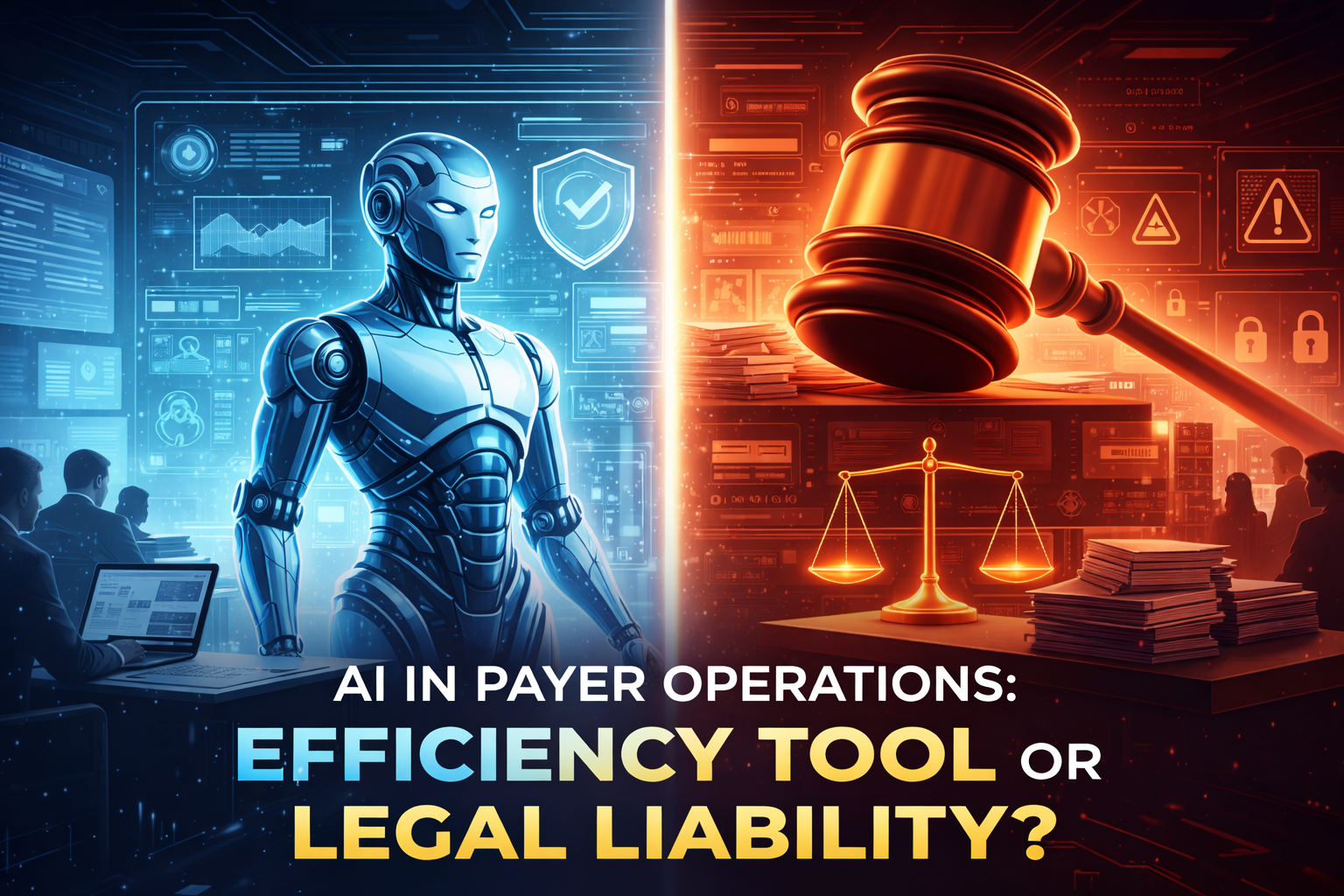
AI in Payer Operations: Efficiency Tool or Legal Liability?
AI is rapidly becoming embedded in core payer operations, driving decisions across claims, prior authorization, and risk adjustment. But as automation increases, so does exposure. The real challenge isn’t adoption—it’s accountability. As AI begins to influence outcomes at scale, payers must confront a critical question: can they explain and defend the decisions their systems are making?
The payer industry is moving fast on AI.
Claims are being automated. Prior authorizations are being streamlined. Risk adjustment is being augmented. Call centers are being replaced with conversational models.
The story everyone is telling is simple.
AI drives efficiency. Efficiency drives margin.
That story is incomplete.
What’s actually happening is this:
AI is moving faster than the controls required to manage it.
And that gap is where the real risk sits.
AI is no longer a support tool. It’s embedded directly into decision-making.
It determines whether a claim is paid.
It influences whether a prior authorization is approved.
It flags what gets reviewed and what gets ignored.
That shift matters.
Because once AI starts making decisions, you’re no longer optimizing workflows.
You’re automating judgment.
And most organizations are not set up to govern that.
There’s a problem building under the surface that few teams are willing to say out loud.
First, accountability starts to break down.
When a decision is driven by an algorithm, ownership becomes unclear.
Was it the plan? The vendor? The model?
In a manual process, responsibility is obvious.
In an automated one, it fragments.
Second, explainability becomes a real issue.
It’s easy to say a model flagged something.
It’s much harder to explain why in a way that stands up to audit, appeal, or legal review.
If you can’t clearly defend a decision, the efficiency you gained becomes irrelevant.
Third, and most important, mistakes scale.
A human makes errors one at a time.
AI makes them thousands at a time.
If the logic is flawed, the impact isn’t contained. It compounds quickly and quietly.
By the time it’s discovered, the exposure is already material.
This is where the industry is headed.
AI-driven decisions are starting to attract scrutiny.
Litigation is emerging.
Regulators are behind, but not indefinitely.
The imbalance is obvious.
Decision velocity is increasing. Oversight is not.
That doesn’t hold for long.
The mistake most payers are making is treating AI like a technology upgrade.
It gets handed to IT.
It gets implemented through a vendor.
It gets measured in terms of cost reduction.
That framing misses the point entirely.
AI in payer operations is not just a technology layer.
It is a decision layer.
And decision layers require control, accountability, and governance.
Right now, many organizations don’t have that foundation in place.
What needs to change is straightforward, but not easy.
Every automated decision needs to be traceable.
Every outcome needs to be explainable.
Every workflow needs to be defensible.
Not in theory. In practice.
Human oversight isn’t going away in high-risk areas.
It just needs to be redesigned around the system, not bolted on after the fact.
AI will continue to expand across payer operations. That’s not the question.
The real divide will be between organizations that deploy it
and organizations that can defend it.
Because the next wave of pressure won’t come from innovation.
It will come from scrutiny.
The question is no longer whether to use AI.
It’s whether your organization can stand behind the decisions it makes when AI is involved.